
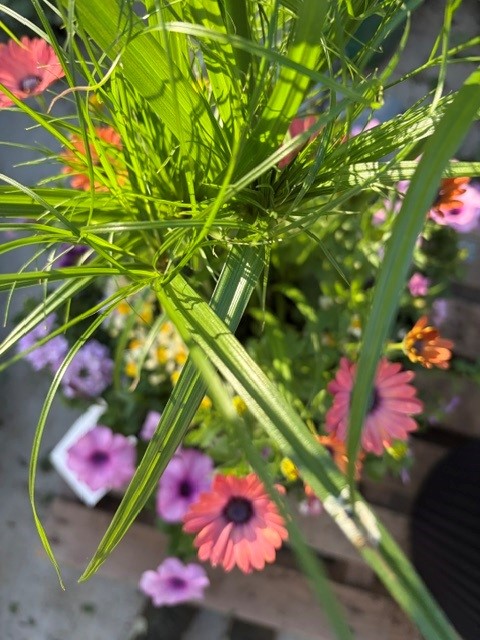
Container Garden Basics
By: Amy Bradley, Horticulture Technician, EM Pd
Growing flowers, vegetables or herbs in containers can create a beautiful display without the need to have an actual “garden”. Container gardening allows for plants with different needs to be grown with their pots side by side, for movement or change of plant material and easy access to plants. Here are a few tips for successful container gardens.
Plants
When choosing plants for containers it is best consider what each plant needs and group them accordingly. Select varieties that have the same watering and fertilizing needs for the same pot. Plants that prefer full sun can be used to shade ones that prefer partial sun, but it is very hard to give one side of a planter water while allowing the other side to be dry. The wonderful thing about planters is that by grouping them together you can have a pot of plants that requires a lot of water beside ones that need to be watered sparingly. Think of a planter full of Siberian Iris Iris siberica, Watercress Nasturtium officinale or Elephants Ear Colocasaia esculenta beside a planter with Rosemary Salvia rosmarinus, Portulaca Portulaca grandiflora. Each of those plants have similar needs and if they are watered accordingly, they will do well beside each other.
Look for plants in a varying arrangement of heights, textures, and colours to create visual interest. Also look at when blooms open. If the container will be close to where you sit in the evening perhaps a Moon Flower Ipomoea alba trained on a small trellis would be a good choice. If you will be in the area earlier in the day them maybe the jewel tones of Celosia Celosia spicata will give a cheerful punch of colour to start your day.
Movement
A great thing about container gardening is that containers, as long as they are not too big, are easy to move around. This makes it easy to swap out pots to change the looks of a display. Seasonal colours, textures and scents can be changed just by removing/adding a few plants in a pot or relocating the whole planter.
Access
Container gardening is a great way to increase access to gardening. By bringing plant material up to an easy to reach height, containers allow those with mobility limitations to comfortably reach plants. When selecting a container, it is important to consider the size of the container with regards to its width. Look for designs that allow the middle or if placed against a wall, the far side of the container to be reached. Consider what tasks (watering, weeding, fertilizing, planting, harvesting, pruning) need to be accomplished without stretching or straining to do so. Keep in mind that a plant that grows to one meter in height will be one meter plus the height of the container.
Containers & Plant Care
Any container used should have adequate drainage, be deep enough to encourage healthy root growth and wide enough to prevent tipping over. Containers can be made from many different materials which may affect how often they need to be watered. Unglazed clay pots will dry out faster than glazed pots, however glazed pots are more expensive. A black pot or container will absorb more heat from the sun than a white pot, this could also affect plant growth.
A potting mix that is light and not compacted is best for most plants – Walter’s sells potting soil in many different sizes for your container growing needs. Pelleted, slow-release fertilizers or compost can be worked into the soil to increase plant health. Water-soluble fertilizers are also easy to use and come in a wide range of strengths. Select the one best for the type of plants that you are growing. Walter’s recommends either GardenPro water-soluble fertilizer or Actisol slow release fertilizer – available for many plant types.
There are several products that will help discourage any squirrels, bunnies, or cats from getting into the soil in planters. One method is to lay chicken wire across the top of the container, letting the plants grow up through it. Another is Pure Hen manure, a multi use product without a strong scent that squirrels and bunnies do not like.
Sometimes it is trail and error, one of the enjoyable things about gardening is that there is always something new to learn, see, smell, and enjoy!